ABOUT

US

CELEBRATING LIFE AND NATURE,
CELEBRATING NAGALAND

The German Consulate in Kolkata supported Contact Base in implementing a project on documenting and safeguarding the authentic intangible cultural heritage (ICH) of selected indigenous communities in Nagaland. The community-based tradition bearers were directly involved in recording their ICH through interviews, storytelling, and performances. This website is designed as a dynamic repository of Naga living heritage facilitated through active community participation.
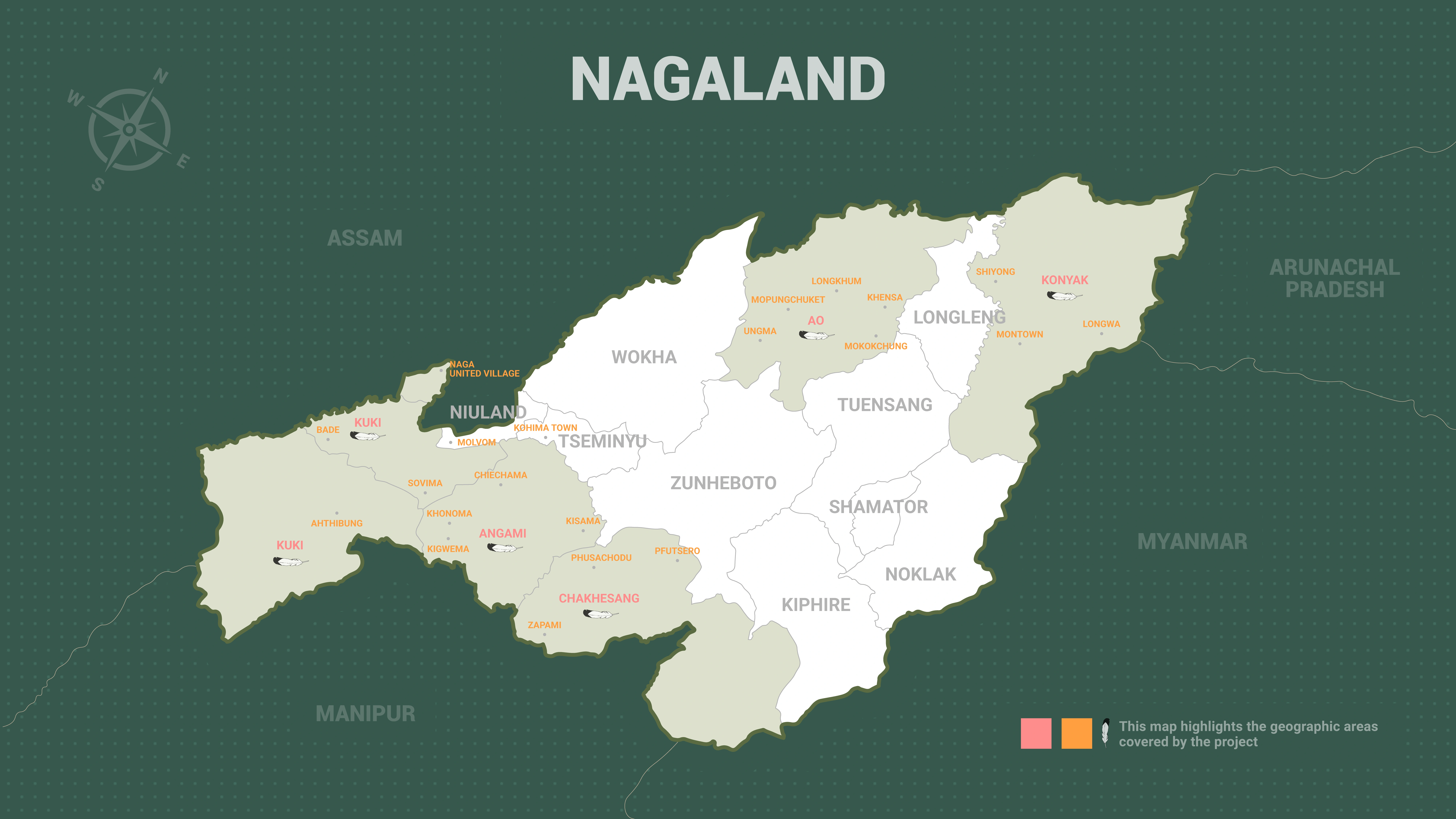
Starting in May 2024, the project covered the Ao, Chakhesang, Angami, Konyak, and Kuki communities from 18 villages and towns across 6 districts—Mokokchung, Kohima, Phek, Mon, Chumukedima, and Dimapur. More than 400 local participants joined the project.

Nagaland is home to 17 major indigenous communities, each with its unique customs, traditions, and languages. However, there is very little awareness inside and outside the state about the distinctiveness of the different communities, owing to a lack of documentation, skill transmission, and declining traditional practices. Unfortunately, the separate ethnic identities have been merged into the uniform identity of ‘Nagas,’ conveying nothing about their rich cultural diversity.

The project fostered collaboration of multisectoral stakeholders, including local artists and artisans, CBOs, NGOs, tourism stakeholders, and educational institutions, through workshops, interviews, and consultations to discuss heritage-sensitive ways of preserving and generating appreciation for Nagaland’s rich ICH and empower local communities to lead the process.
Intercultural exchanges were also organised to create a collaborative space for learning and inspiration at the intersection of tradition and modernity, cultural diversity, and similarities. One of the unique collaborations focused on traditional skill-based heritage innovation and sustainable designs in basketry and the diverse natural fibres of Nagaland. Hege Aasdal, a renowned Norwegian basketry designer, worked with Nagaland-based designer Aku Zeliang and indigenous basketry artisans from different communities to reimagine and co-create innovative natural fiber products. Similar creative collaborations were also led by Swarup Dutta, a reputed scenographer and designer, along with his team from Kolkata, who worked with the Naga craft practitioners of bamboo, banana fibre, and wood to develop a beautiful collection of composite home products.

The goal was not only to develop a beautiful collection of products but also to explore how traditional crafts can be adapted for contemporary markets while preserving their cultural heritage.
Communities were engaged in participatory workshops to identify and document their Intangible Cultural Heritage (ICH) assets, including significance and oral histories, using audiovisual and textual methods.

IMAGE GALLERY