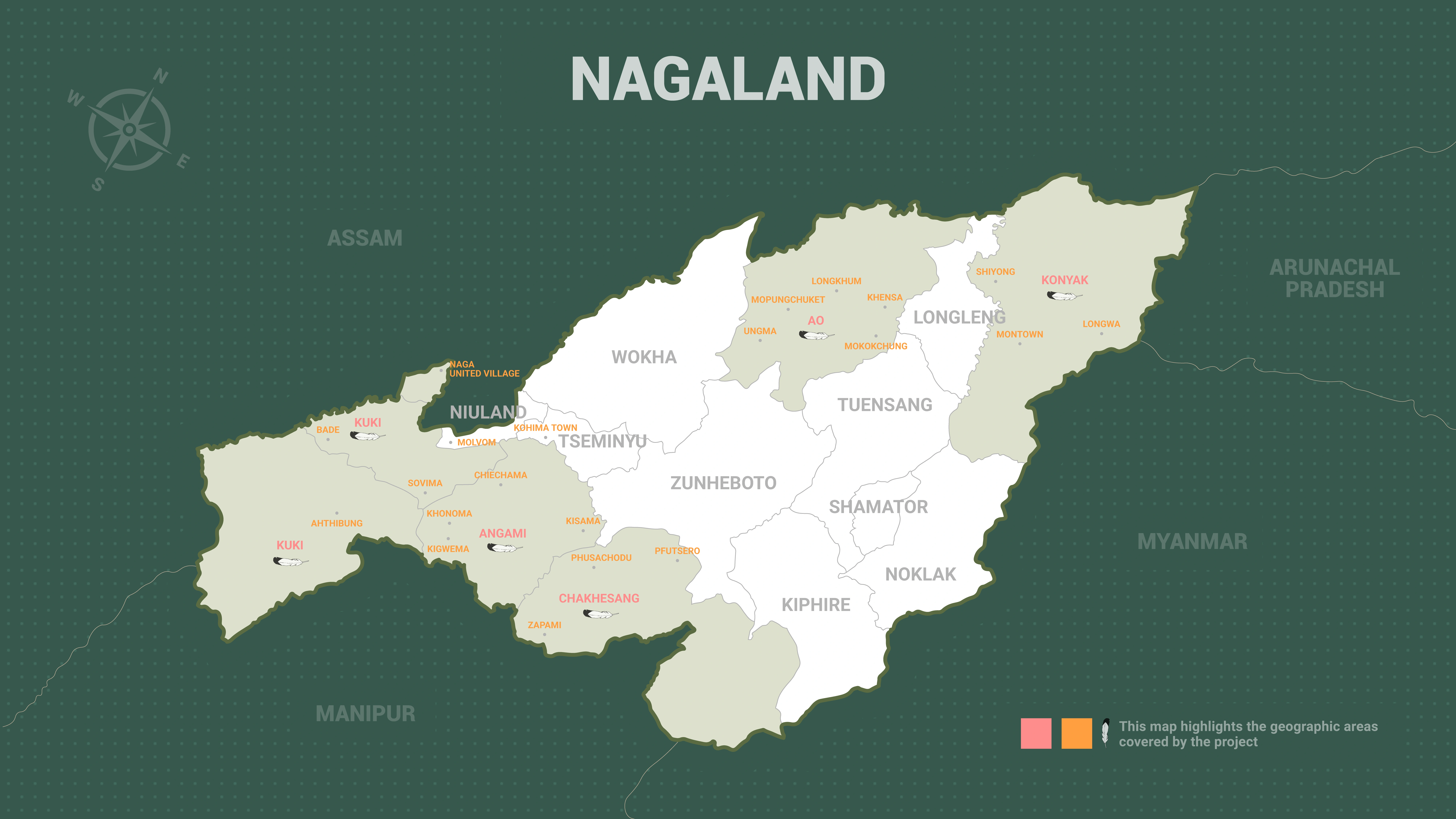
The Chakhesang community, though with origins in the eastern Agami group, has forged a unique identity with its own name, dialects, and cultural practices. The Chakhesangs mainly reside in the Phek district. Their four predominant dialects are Sumi, Khezha, Chokri, and Sapuh. The word ‘Chakhesang’ is believed to be derived from 3 words—‘cha’ from ‘chokri,’ ‘khe’ from ‘khezha,’ and ‘Sang’ from the Sangtam community. Some say that in the 1960s the Sangtams of erstwhile Kohima district chose to merge themselves with the eastern Angamis and then the Chakhesangs.
Wrestling is their main sport, organized during festivals. Kite-flying is also practiced. Agriculture is the main occupation. They practice terrace cultivation. A wide variety of crops are grown throughout the year, many of which are unique to the region, including different species of paddy, indigenous cotton, and local vegetables.
In the Chakhesang community, home architecture carries significant cultural meaning. Only individuals who host ceremonial feasts, known as ‘feasts of merit,’ are granted the privilege to design their homes with specific symbols and designs such as the Mithun and pig heads, carved wooden panels, and house horns. These homes in a village reflect the generosity, high social status, and wealth of the hosts.
Chakhesang women are excellent weavers. The Chakesang shawl is GI tagged representing wealth, and peace. They use loin looms to make their traditional attires—wraparounds and shawls. The use of diverse colour schemes, patterns, and symbols represents a person’s social status, power, and role in the community. Nettle fibre weaving is particularly unique to the Chakhesangs.
The Chakhesang People’s Organization is the local nodal body facilitating cultural conservation. Through various community-based organizations and the village councils, they preserve the age-old traditions of community-led governance and social order, customs and practices, textiles, handicrafts, food, cultivation, songs, dances, and architecture.









.webp)
.webp)
.webp)
.webp)
.webp)


.webp)
.webp)
.webp)
.webp)
