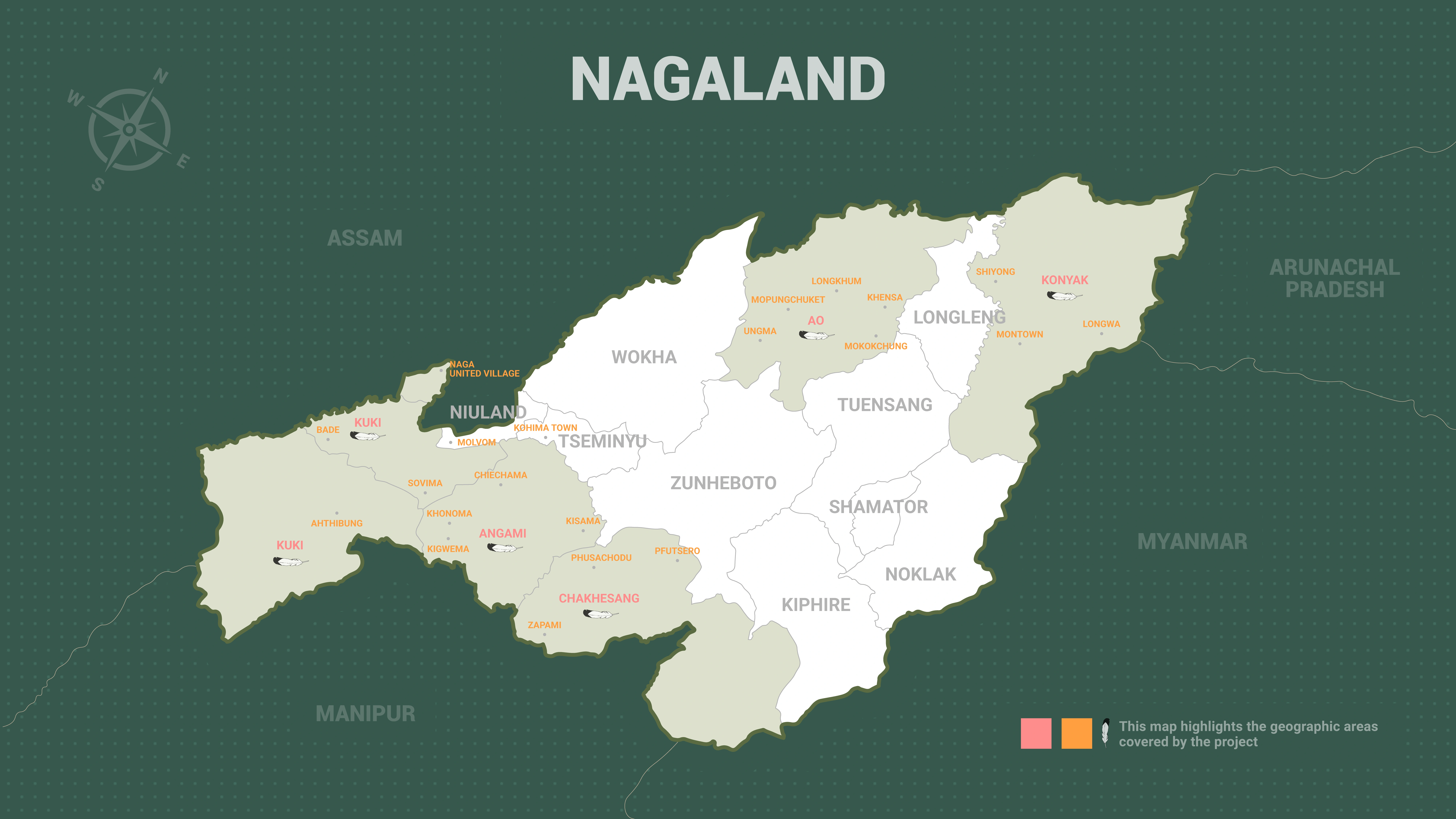
Tap to zoom in the map
The Chakhesang community is widely admired for its refined aesthetics and rich cultural heritage. Among its many artistic traditions, one stands out for its uniqueness and deep-rooted cultural symbolism—the weaving of stinging nettle fibre, locally known as thebvo. This indigenous fibre is extracted from the stinging nettle plant, which grows abundantly in the forests surrounding Zapami village, the birthplace of this remarkable craft.
For generations, the women of Zapami have harvested and processed this organic fibre entirely by hand, transforming it into beautiful shawls that carry both practical and symbolic value. More than a craft, thebvo is a living tradition and a marker of identity for the Zapami community. It is celebrated as the official attire on special occasions like Zapami Cultural Day and Women’s Day, reflecting the community’s deep pride in their heritage.
During visits and conversations with community elders and leaders, it became clear that thebvo represents more than just traditional clothing—it embodies the spirit and origin of the village. It is seen as a symbol of equity, signifying a harmonious balance across gender, age, culture, and social standing in Zapami.
Historically, thebvo served various roles beyond everyday clothing. It was used as quilts, wraps during wartime to carry enemy heads, and as slings for transporting harvested paddy. “Thebvo is with a person from birth till death,” say the villagers, emphasizing its integral connection to life and the values of the community.
The making of thebvo is an intricate, labor-intensive process, passed down through generations of Zapami women. Harvesting occurs between November and February when the stinging nettle plants are at their best. The bark is stripped and sun-dried before entering the meticulous multi-step process of fibre extraction and preparation.
Mechi Keru: Manual removal of the plant’s prickles.
Thebvo Tenyi: Hand-kneading to clean and discard the outer layers and impurities.
Soaking & Splitting: The cleaned fibres are soaked and then delicately split into fine filaments called thebvo kho.
Thebvo Melu: The fine splits are thigh-reeled into long, slender yarn strands.
Che Ketsu: Yarn strands are rolled into balls.
Lumih Spinning: The yarn balls are soaked again and spun using a traditional spindle known as lumih.
Lo Re & Lotatsu: The spun yarn is sorted into hanks (lo re), sun-dried, threshed, cleaned, and treated with pounded white rice to enhance durability and luster—this final refinement is known as lotatsu.